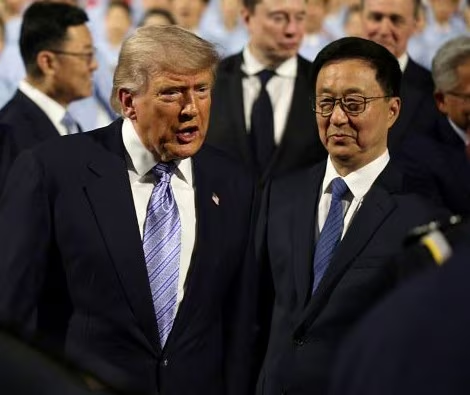
The Chinese embassy is warning that there are “four red lines” President Donald Trump must not challenge during his meetings this week with Chinese President Xi Jinping.
In one post on social media Tuesday, the embassy posted a graphic stating that the United States, during Trump’s meetings, must not challenge the “Taiwan question,” China’s record of democracy and human rights, the nation’s path and political system, and “China’s developmental right.”
In another X post, the embassy emphasized that “China and the US should explore the building of a strategic, constructive, and stable China-US relationship,” adding that “mutual respect, peaceful coexistence and win-win cooperation remain the right way for China and the US to get along.”
Beijing has repeatedly warned Washington against expanding military or political ties with Taiwan, which China claims as part of its territory.
Trump arrived in Beijing on Wednesday ahead of a scheduled bilateral meeting with Xi on Thursday.
The leaders are expected to discuss the Iran war, trade relations, and U.S. arms sales to Taiwan during the talks.
“We’re the two superpowers,” Trump told reporters Tuesday before leaving the White House. “We’re the strongest nation on Earth in terms of military. China’s considered second.”
The administration is facing bipartisan pressure from lawmakers to continue supporting Taiwan militarily despite objections from Beijing, The Hill reported.
Eight Republican and Democrat senators wrote to Trump on Monday, urging him to move forward with a proposed $14 billion arms sale to Taiwan.
“President Xi would like us not to,” Trump said when asked about the proposed sale before leaving for China.
Trump also said he expects Xi to raise the Taiwan issue during the meeting, “more than I will.”
Chinese officials also used the warning to push back against U.S. criticism of Beijing’s political system and human rights record, warning Washington not to “challenge, smear, or even try to subvert” China’s political model, according to NDTV.
The warning about development rights appeared aimed at ongoing U.S. trade restrictions and technology controls targeting China.
Chinese officials have accused Washington of attempting to contain the country’s economic growth through tariffs, export controls, and limits on advanced semiconductor access.
Human rights concerns are also expected to surface during the talks. Lawmakers and advocacy groups have urged Trump to press Xi on the detention of American citizens and political prisoners held by Chinese authorities.
Trump told reporters he plans to raise the cases of Christian pastor Ezra Jin and Hong Kong media mogul Jimmy Lai during discussions with Xi. Lai has become a high-profile symbol of Beijing’s crackdown on dissent in Hong Kong.
The ongoing Iran conflict is also expected to play a major role in the discussions between the two leaders.
China remains the largest purchaser of Iranian oil and has been affected by disruptions tied to the effective closure of the Strait of Hormuz, a key global shipping route.
Secretary of State Marco Rubio said last week that the United States hopes Beijing can use its influence with Tehran to help reopen the waterway and reduce tensions in the region.
Trade negotiations are also expected to continue during the visit. Trump’s tariffs on Chinese imports strained relations between the two countries, although both sides agreed to a temporary trade truce after meeting in South Korea last October.
Officials from both countries are expected to discuss possible extensions of the trade agreement and explore new economic partnerships at the Beijing summit.