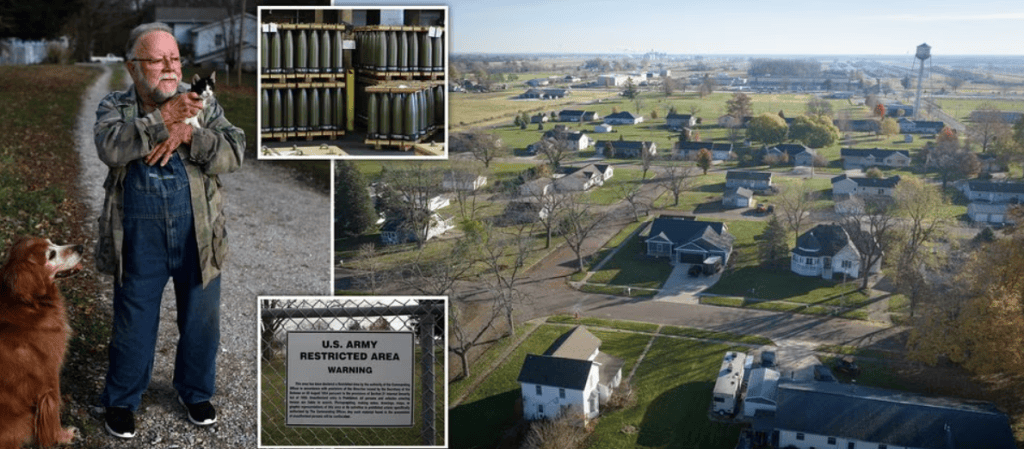
The US Army has been cleared to detonate nearly 10,000 pounds of toxic explosives in Iowa, despite outcry from residents. The greatest danger will be to anyone within the Army’s projected plume in the first hour after the explosions.
Thousands of families in Iowa are bracing for potential toxic fallout as the Army prepares to destroy nearly 10,000 pounds of dangerously unstable explosives.
An emergency alert warned residents five to 20 miles from the Iowa Army Ammunition Plant near Middletown to stay indoors with windows closed ahead of Wednesday’s planned 9am local-time detonation.
Residents in Middletown and a five-mile cone southwest of the plant have been urged to leave temporarily. Others in potentially affected areas have been advised to remain indoors for up to 48 hours afterward, raising the prospect of precautions stretching into Thanksgiving.
The Army confirmed late Monday that it would proceed with the controlled detonation of 68 barrels of lead azide at the southeastern Iowa installation, citing ‘unanimous’ backing from the federal agencies involved.
A federal appeals court lifted a temporary stay earlier Monday, clearing the way for the operation after officials warned that the deteriorating explosives had become too dangerous to move. Maj Gen Eric Shirley said at a Tuesday press conference that ‘inaction is no longer an option,’ adding that military specialists had been rehearsing the operation.
The detonation could send lead-containing particles drifting downwind, creating a risk of exposure through breathing airborne dust or ingesting particles that settle on surfaces.
Dr Dan McCabe, medical director of the Iowa Poison Control Center, said: ‘Lead poisoning is a serious issue. The health concern from this event is lead, not azide.’
He said lead poisoning almost always develops through exposure lasting weeks, months or years, adding: ‘A brief exposure is rarely a medical emergency.’s.
The “carefully controlled detonation” at a facility in southeastern Iowa will go ahead after a decision by multiple federal agencies, acting Army secretary Adam R. Telle said late Monday.
Local residents have been told to stay indoors for up to 48 hours, effectively keeping them housebound over the busiest travel season of the year.
“I’m really angry about this. I feel like we’re guinea pigs,” Krys Plate, who lives about two miles south of the Army’s fence line around the stockpile, told the New York Times.
“We didn’t have any communication from anybody officially. This could have been done way better,” Plate’s husband Jim told the Times.
The family thought they would be spared the disruption when the explosion of lead azide was initially planned for Friday, amid winds that would have blown the material northward.
But with the delay of the blast to this week, the home they share with their two teenage daughters is now potentially at the center of a plume of lead dust.
“I’m terrified. Everybody knows that the acceptable level of lead is zero,” Ms. Plate said, ahead of Monday’s decision.
Lead azide, a sensitive explosive used to trigger munitions, has been stored at the installation for more than two decades.
Changes in the liquid used to stabilize it have allowed the material to recrystallize inside its containers, increasing its sensitivity to shock and friction and creating a risk of an uncontrolled explosion, according to court documents.
Acting Army Secretary Adam Telle said on X Monday night: ‘Every expert agency agrees, and both Iowa’s current and incoming Governors say the call belongs to the experts.
‘We are proceeding with the controlled removal in full coordination with all state, local and federal authorities, because the safety of Iowa’s citizens comes first.’
In March, the Army determined that the stored lead azide had degraded and become unstable.